The Empty Bed Cost: What Is Your Housing Vacancy Really Costing You?
An empty bed may look like a small operational issue. Perhaps a student withdrew, a room never filled, a returning resident chose to live off campus, or housing demand was overestimated. Staff may see one more room to clean, inspect, or prepare for the next semester.
But from a financial perspective, an empty bed represents something much bigger: housing revenue that may never be recovered, while many of the costs of operating the building continue.
For colleges and universities, residential housing is more than a place for students to sleep. It is an important part of the student experience and, at many institutions, a self-supporting operation that must generate enough revenue to cover operating expenses, maintenance, and debt service. The California Legislative Analyst’s Office explains that campus housing programs traditionally rely on rental revenue to support these costs.
So, what does an empty bed actually cost your institution? And how can Residential Life professionals work with finance, enrollment, and facilities teams to reduce the impact?
Let's break it down.
1. An empty bed is lost revenue—not necessarily lost expenses
When a student does not occupy a bed, the institution generally loses the housing revenue associated with that space. However, most building costs do not disappear just because a room is vacant.
Your institution may still be paying for:
Building debt service, leases, or other fixed obligations.
Salaries and benefits for full-time staff (even if only 6 students live in the residential hall).
Heating, cooling, internet, and building-wide utilities.
Insurance, security, and routine maintenance.
Scheduled inspections, preventive maintenance, and building upkeep.
Software, administrative systems, and other operational expenses.
Some costs may decrease when occupancy falls. For example, fewer residents may mean less water consumption, fewer consumable supplies, or reduced turnover cleaning. But these savings are usually different from the full housing charge that would have been collected.
2. The cost of one empty bed
Let's use a hypothetical university to illustrate the financial impact.
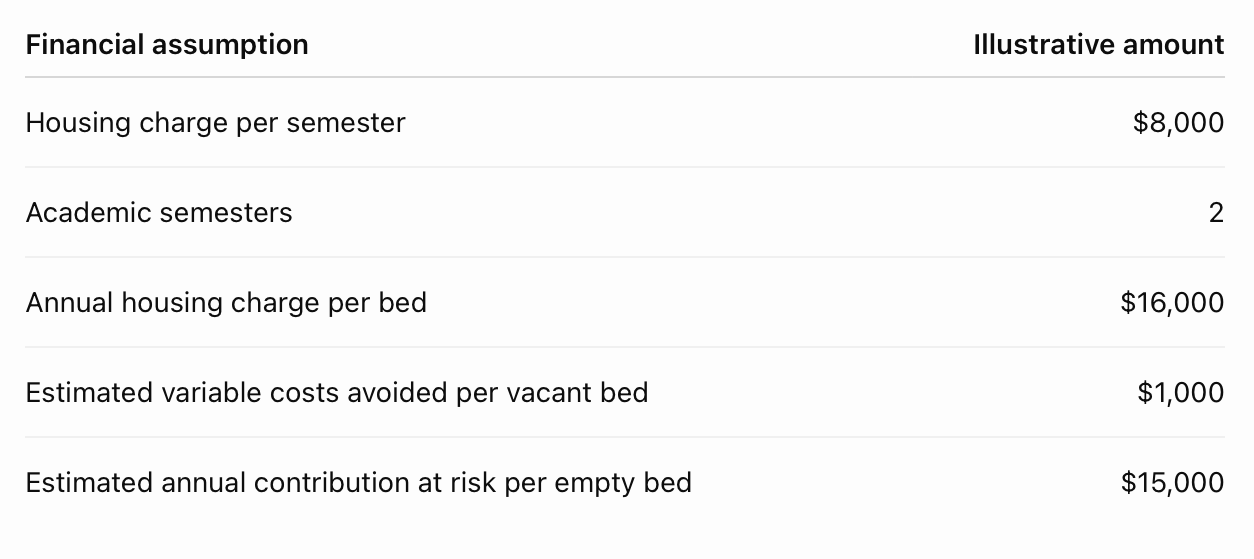
Assume the institution charges $8,000 per student per semester for housing, with two semesters in the academic year. This would come to $16,000 per student per academic year.
In this example, one bed remaining vacant for the full academic year represents $16,000 in potential gross housing revenue. If the institution avoids $1,000 in variable costs, the estimated contribution at risk is $15,000.
This is not a universal industry rate or a prediction of any particular university's finances. Actual figures depend on the housing contract, room type, refunds, financial aid arrangements, meal-plan treatment, variable costs, and whether the space could realistically have been filled.
3. Ten empty beds can change the budget
The impact becomes more visible when we look beyond one room.
Using the same illustrative assumptions:
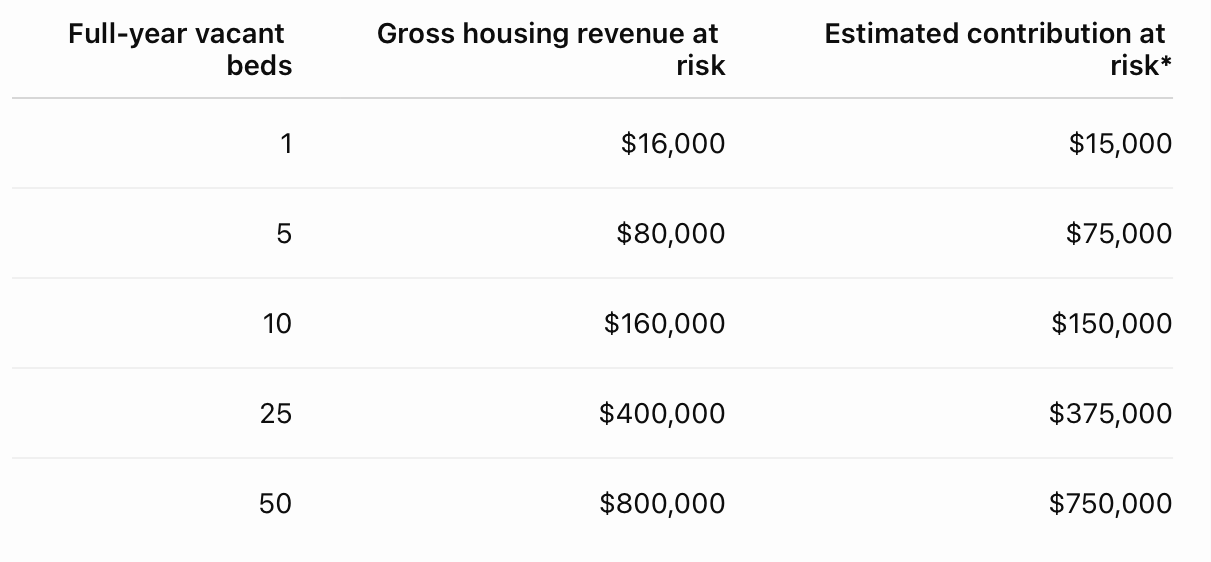
Imagine a residence hall with 500 available beds. If 25 remain empty for the academic year, the institution could have $400,000 in gross housing revenue at risk under these assumptions.
That is not a minor room-assignment issue. It is a budget variance that deserves attention from Residential Life, enrollment management, finance, marketing, and senior leadership.
And the impact can extend beyond the immediate budget. Persistent vacancies may affect future staffing plans, capital planning, maintenance reserves, and the institution's ability to reinvest in residential communities.
4. What happens when occupancy drops?
Occupancy is one of the simplest ways to understand how much of a residence hall's capacity is being used.
Consider a hypothetical institution with 500 available beds and an annual (academic year) housing charge of $16,000 per bed.
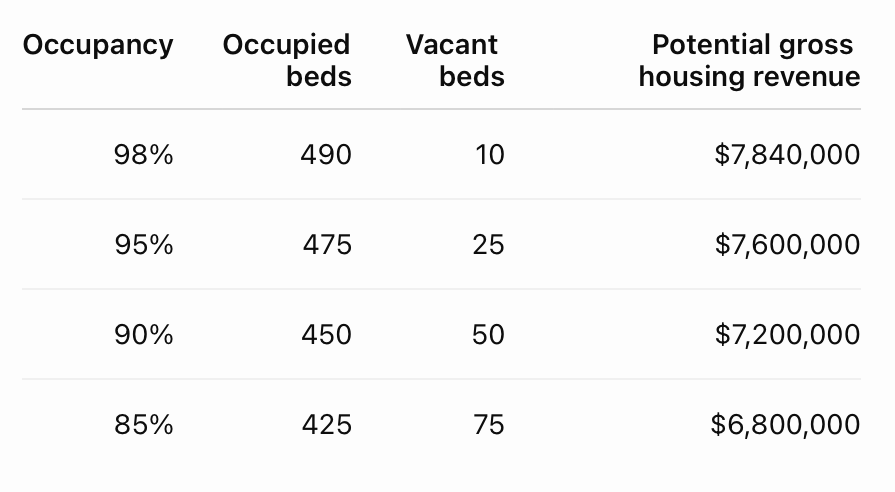
The difference between 98% and 90% occupancy is 40 beds. Under this model, that difference represents $640,000 in potential gross housing revenue for the academic year.
The important lesson is not that every institution should target 98% occupancy at all costs. A university must also consider room availability, accommodation needs, maintenance closures, student choice, affordability, and whether enough appropriate spaces are available for the students who want them.
The goal is to understand the financial consequences of occupancy changes and make decisions using reliable data—not to fill every bed regardless of student needs.
5. Why vacancies happen—and why the answer is not always more marketing
Before an institution can address empty beds, it needs to understand why they exist.
Vacancies can be caused by several different issues:
Enrollment and demand
Fewer incoming students than anticipated.
Changes in the number of students seeking on-campus housing.
Competition from off-campus apartments or private student housing.
Shifts in student preferences, including room type and price.
The housing ‘product’
Too few single rooms or accessible options.
Bathrooms, amenities, or layouts that no longer meet student expectations.
Prices that do not align with the perceived value of the experience.
Room types that do not match the needs of the students applying.
Operations and communication
Complicated applications or unclear deadlines.
Delays in processing applications or confirming assignments.
Poor communication about availability, costs, or contract terms.
Cancellation policies or assignment processes that create avoidable friction.
The residential experience
Students who do not feel connected to their community.
Concerns about safety, inclusion, cleanliness, or maintenance.
Limited opportunities for engagement and belonging.
Returning students who do not see sufficient value in living on campus again.
These causes require different solutions. A marketing campaign will not fix an inaccessible bathroom. A renovation will not solve a confusing application process. More programming will not resolve a housing rate that students cannot afford.
The first step is diagnosis.
6. Five actions Residential Life leaders can take
1. Track occupancy throughout the year—not just at move-in.
A building that opens at 96% occupancy may experience withdrawals, cancellations, room changes, or students moving off campus. Weekly or monthly tracking helps teams identify patterns before the end-of-term financial report.
2. Review vacancies by room type and building.
An empty premium single room may have a different financial impact from an empty double-occupancy space. Building-level averages can hide important differences.
3. Examine the student journey.
Review application completion, deposit conversion, assignment timelines, cancellation reasons, and the communication students receive. Small administrative barriers can become lost housing opportunities.
4. Connect retention with the residential experience.
Ask students why they choose to stay, leave, or live elsewhere. Look at maintenance satisfaction, affordability, belonging, accessibility, amenities, and community engagement. Retention is not solely a Residential Life responsibility, but the residential experience can be an important part of the decision.
5. Bring the right teams together.
Residential Life, admissions, enrollment management, finance, facilities, marketing, and student affairs each see a different part of the problem. A shared occupancy dashboard and regular review meeting can turn disconnected information into coordinated action.
Final thought: Every bed tells a story
An empty bed can represent a missed enrollment opportunity, a price point that no longer fits, an outdated room design, a frustrating application process, or a student who did not feel that campus housing was right for them.
The financial implications deserve attention—but so do the experiences behind the numbers.
At Campus Nest, we believe strong residential communities are built through intentional design, thoughtful operations, meaningful assessment, and a commitment to student success. Understanding the empty bed cost is one way to connect financial sustainability with the broader mission of residential life.